Light Fields
CS 348B - Computer Graphics: Image Synthesis Techniques
Spring Quarter, 1997
(TA) Lucas Pereira
Lecture notes for Tuesday, May 13, 1997
Handout #26
Light Fields
Contents:
- Introduction: Image-based rendering
- Background
- The light field
- Light field parameterization
- Is this really rendering at all?
- Sampling issues
- The line space dual
- Light field generation
- Light field compression
Introduction: Image-based rendering
- Image-based rendering - Creating new views of a 3D
environment based on existing images
- Why would we want image-based rendering?
- Speed, Realism
- Raytracers can't do 30 frames a second
- Infinite Not-Quite-Reality
- Advantages:
- Speed, independent of scene complexity
- Source of images: real or synthetic
- Disadvantages:
- Memory usage
- Finite Resolution
- Possibly high precomputation costs
(such as raytracing a billion pixels)
- Where have we seen image-based approaches before?
- Texture-mapping
- Faster than a million polygons
- More realistic than a Gouraud-interpolated plane
- Environment-mapping
- Direction-dependent
- "Environment" picture mapped onto planes that
don't really exist, but provide a nice
parameterization
Background
- Chen & Williams (Siggraph '93)
- When doing real-time fly-throughs, images are coherent
(similar)
- Morphing in-between images faster than rendering every
image
- Computing the warp: depends on object depth
- Inverse velocity gives depth
- Differences in depth cause missing pixels
- QuickTime VR
- panorama: 360-degree field of view, discrete locations
- Viewer "jumps" from one discrete location to another
- object: discrete locations around the object
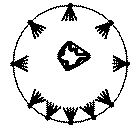
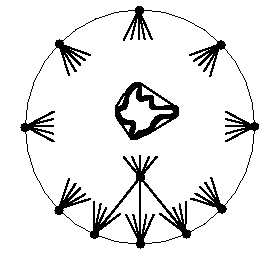
The light field
- Samples the 4D flow of light in free space.
- Can reconstruct any view inside the convex hull (for
outward-looking) or outside the convex hull (for inward-looking)
- Webster Definitions:
- Light - electromagnetic energy in the visible
spectrum
- Field - a region or space in which a given effect
(such as magnetism) exists
- Render - to reproduce or represent
- Light field Rendering - To reproduce or represent an object
using the distribution of visible electromagnetic energy
over a region of space
- Plenoptic Field - from latin "plenum", which was
once thought to be the ether through which
light flowed
Light Field Parameterization
- Fully general parameterization: from every point in space x,y,z (3D), x
the light travelling in every direction s,t (2D), = 5D
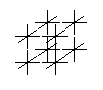
- Equivalent to having an environment map for every
point in space
- Expensive - in free space, rays don't change along their
length
- 2-Plane parameterization: light in free space
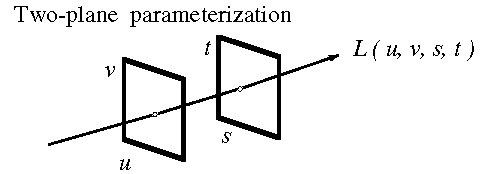
- Each u,v,s,t specifies a unique line in freespace
- Planes can be arbitrarily placed, even at infinity
- Singularities: intersections, both planes at infinity
- Everything is linear - an image from anywhere in space
is a planar 2D "slice" in the 4D volume
- This makes it easy for computers to compute quickly
Is this really rendering at all?
- Rendering: Generation of a 2D image from a 3D scene
(from lecture #1)
- Light fields satisfy that definition
- Ways to think about light fields
- A rendering method
- An object representation format
- A caching method
- A hidden-surface algorithm, with reflectance maps
- An object simplification algorithm
Sampling issues
- Prefilter:
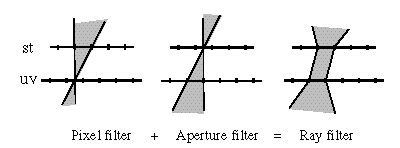
- Each u,v,s,t pixel represents all the rays that
pass through these two filter regions
- Postfilter:
- Quadralinear interpolation: convolve triangle filter
in all 4 dimensions
- This can be implemented as a bilinear interpolation
between 4 bilinearly interpolated samples
- 16 samples contribute to each screen pixel
- Faster: bilinear interpolation
- Choose only two dimensions to filter, such as u-v
- If we do this, we might want more resolution in
the un-filtered two dimensions
- Example: typical light field
64x64 in uv, 256x256 in st
- Fastest: point sampling
- Grab the closest sample
- See "jaggies" both in uv, and st
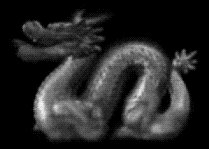
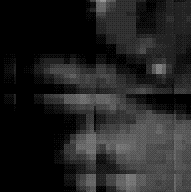
- Minification:
- Can build multiresolution pyramid, which would
be 5D (An linear array of 4D structures)
- Each level up is 1/16 the size -- So cost of
the pyramid is trivial
The line space dual
- Nonuniform spatial resolution
- A light field does not have uniform resolution throughout
space
- Uniform resolution impossible:
- Memory is finite
- 4D space is infinite
- Uniform resolution everywhere means average
resolution is (memorysize / infinity), which
is 0
- Nonuniform resolution hard to visualize
- What do we care about, to generate an image of light field?
- From a given viewpoint, what is the sample spacing
- From a given viewpoint, what is the angular
distribution
- The line space dual (in 2D)
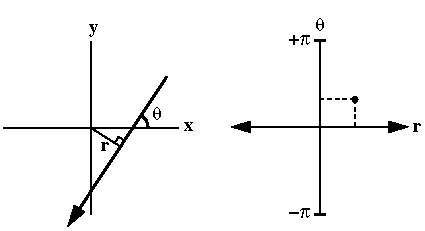
- Lines in Cartesian space map to points in line space
- Parallel lines map to a horizontal line in line space
- Lines that pass through a single point map to a
vertical line in line space
- Density of points in line space show light field resolution
in Cartesian space
Light field generation
- Object placement
- Typically, a surface has higher spatial variation than
angular variation
- Remember bilinear filtering is cheaper, so we often
have nonuniform spatial resolution
- Place object so that its spatial variation corresponds
to highest region of spatial resolution
- If st plane is higher resolution, place object near st plane
- Often refer to st plane as "focal plane", and uv as
"camera plane"
- Effects of low linespace resolution: blurring
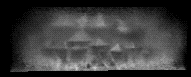
- Sheared projection
- Each view from a uv "camera location" is a sheared
projection
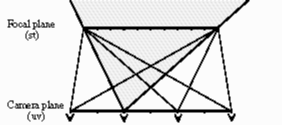
- For acquired light fields, camera was rotated instead of
sheared, so we have to warp the images
- For synthetic light fields, shear is not a problem
Light Field Compression
- Two big disadvantages: memory usage, finite resolution
- Closely related: without memory restrictions, we could
do far higher resolution
- Solution: compression
- Light fields have huge coherence
- Each closely-spaced image is very similar
- Surface reflection map generally low frequency
- Current solution: vector quantization
- Codebook represents block of pixels
- Codebook learned on "training set"
- Indices choose best codebook for each tile of light field
- Typical:
- 2-byte index (64K Codebook entries)
- 2x2x2x2 pixels, x3 colors = 48 bytes
- compression: 48:2, or 24:1
- Example: Buddha light field
- 32 x 32 x 256 x 256 x 3 = 192 MB
- 24:1 compression = 8 MB of indices
- 32K codebook entries x 48 bytes = 1.5 MB
- Total size: 8 + 1.5 = 9.5 MB
- Future solution: "motion" estimation?
- In epipolar space (e.g. u-s), points in space form
lines in a light field
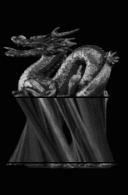
- Slope of the line depends on depth of the point
- We are trying to represent this set of lines as
a textured polygon and motion vectors
- Similar to mpeg, in theory
- In practice, needs to be random-access for rendering
- Calculating "velocity" of the planes equal to
Chen & Williams calculating depth
- Then, just render the textured polygon in the right
place, to get 4D sample
- Once again, we only filtering in 2D
- This is reminiscent of hidden surface algorithm,
where for each local area, there is only
one valid plane
- This is the topic of my current research (along with
Ben Zhu)
lucasp@graphics.stanford.edu
Copyright © 1997 Lucas Pereira
Last update:
Tuesday, 13-May-97